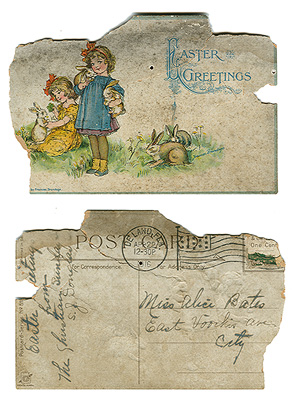
Click to Enlarge Easter Greetings: Postcard from the year 1916 found in the walls of a crumbling house, gave hope of rehabiliting the crimefilled "Crack Alley". |
For roughly 85 years it had lain behind a closet wall, a memento of a time when a crime-ridden slum known as "Crack Alley" was a well-kept, family neighborhood.
It was a penny postcard, dated April 22, 1916. All it was supposed to contain was an Easter greeting for a little girl. But, when it was recovered from it's hiding place a few months ago, it also held a message of hope for Michael Arth.
Arth found the postcard when he and a work crew began renovating a house at 216 E. Voorhis Ave., DeLand. The postcard showed Arth that, at one time, the neighborhood around the house had streets filled with playing children instead of nodding junkies and cruising prostitutes.
Arth took the postcard, which had grown brittle with age, and carefully put it in a photographic album he was compiling. Pictures in the album showed what "Crack Alley" had been and how he was going about changing it.
Apparently, the girl to whom the card was addressed, Alice Bales, was playing with it in an upstairs closet. She stuck it in a crack in the baseboard, and it fell down, getting caught behind the wall of another closet under the stairs of the two-story home.
There it stayed. Alice's former home remained a single-family home as other houses in the neighborhood eventually were converted to apartment houses and duplexes. Middle and upper-middle-class homeowners sold out, leaving the neighborhood for the suburbs.
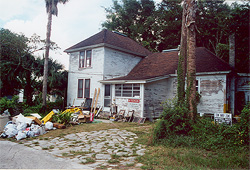
Meanwhile, age and a lack of care by often-absentee landlords took their toll on many of the houses. Paint peeled. Wood rotted. Brick, stone and masonry became encrusted with dirt. Lawns became overgrown with weeds and filled with trash.
The neighborhood around the house -- bounded by Howry Avenue on the north, Walts Avenue on the south, Alabama Avenue on the west and Amelia Avenue on the east -- became a haven for drunks, hookers, and drug dealers and users. Locals and cops created the nickname "Crack Alley," shortly after crack cocaine became the drug of choice among the lower echelons of criminals.
Arth, now 48, never heard of DeLand, let alone "Crack Alley" for most of his life. Growing up in Texas, he developed a fascination for building and architecture. But, his main passion was reserved for art. He toured the United States and Europe with exhibitions of his posters, illustrations, photographs and prints. He published a coffee-table book, Michael E. Arth: Introspective 1972-1982, in 1983.
Although he never got a degree in architecture, Arth also never lost his childhood love of building design. By the late 1970's, he had melded his art background with building design. He became a contractor, working on multimillion-dollar projects in Southern California. He married and lived in that Valhalla of Southern California chic, Santa Barbara.
Along the way, he became fixated on the idea of urban planning to renovate cities. He began working on designs to solve such problems as highway congestion by designing the neighborhoods in which pedestrian traffic is encouraged over vehicles. He began a second book, tentatively titled The Labors of Hercules: Modern Solutions to 12 Herculean Problems, in which he outlines his ideas for combating urban blight.
But his ideas had gotten no further than drawings on paper of such things as streetscapes. Arth began to think of some way to find a real-life laboratory in which he could test his ideas. Then, while surfing the internet in November 2000, he came across a real-estate listing by DeLand civic booster Maggi Hall, now owner of West Volusia Properties. Hall was promoting a redevelopment plan for southern DeLand that she called the "Voorhis Street Project."
Her idea fired Arth's imagination. He telephoned her and, over the next few weeks, a project called the "DeLand Garden District" was born. It was to be Arth's laboratory. He eventually contracted to buy 27 buildings in and around "Crack Alley". The project would consume the next two years and about $1.1 million. That would be about the amount it would cost to buy and renovate one house in Santa Barbara, according to Arth. So, the thought of redoing an entire neighborhood for that money was irresistible.
Click
To Enlarge
216
E. Voorhis Ave. at the time |
Click
To Enlarge
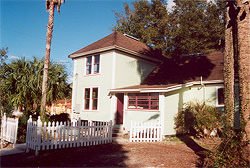
The
house as it is now, nearing |
Arth arrived in DeLand on a dark night in December 2000 and showed his wife, Maya, the area that would become both the proving ground for his redevelopment ideas and the couple's new home.
Maya, now 26, was a native of Bulgaria who spent most of her life in Santa Barbara. She was unused to the sight of hookers trolling the streets for clients and of junkies and drunks passing out on sidewalks.
"DeLand just looked terrifying when we came here during the night," she said. "I couldn't see the potential. I couldn't even understand what the people were saying on the streets."
But her husband soon convinced her of the potential that lay under the years of crud that had formed on the buildings. Despite decades of neglect, the structures still were vestiges of the Victorian and Edwardian eras. They still could be restored to a stately, picturesque glory.
Still, Michael wisely sent Maya off to live with her parents in Bulgaria while he got rid of the prostitutes, drug dealers and winos who infested his properties. Along the way, he collected more than a few threats and a lot of scares. But he never actually was harmed.
"I had to pretend to myself on a number of occasions that it really wasn't as dangerous as it probably was," he said. "The police and everybody else told me to get a gun. If I had a gun, it probably would have made it seem more dangerous."
At one point, he did pay cash to get some dealers to leave. But, despite a few broken windows from disgruntled dealers and a stolen van and missing cash courtesy of a drugged-out employee from the neighborhood, Arth pressed on with his plans. He hired painters, carpenters and plumbers. Every time he started to get discouraged, something, like the discovery of the postcard, would show up and keep him going. As the neighborhood improvements became obvious to anybody driving by, bank financing for the project got easier.
Maya rejoined him. Seven weeks ago, the couple moved into what had been a crack house, where about 50 customers used to come and go each night for either drugs or sex. The night the Arths moved in, the couple's first child, Sophia Evelyn, was born in the house.
Sophia's birth was yet another of those signs, like the postcard, that Arth believes are telling him to keep on with the work. He envisions putting in a fountain, complete with artificial rocks and waterfall, by a trendy restaurant in the heart of the district. He plans an art museum for a former grocery store that had been condemned by the city and was about to be torn down before Arth bought it.
"It really has all been a leap of faith," he said. "Faith is a good word for it. It's like there is some power directing all that's beyond me."